
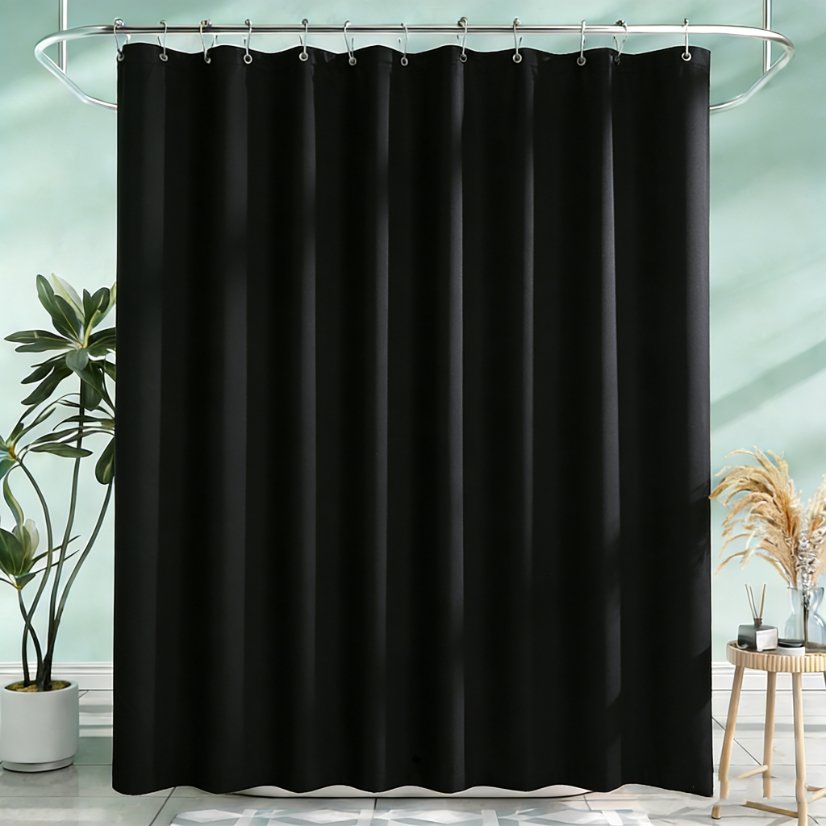
When a shower-curtain catalogue places GSM values under a thickness heading, ask the supplier to define the property being quoted before comparing offers. Request confirmation of whether the entries describe mass per unit area, and ask for physical thickness as a separate field if your buying brief needs it. Jiaguan Homeware’s black-curtain page uses this heading and unit combination. Treat it as a clarification question for the exact offered version, rather than converting the listed number into an unsupported thickness or performance statement.
Name the property, unit and product version
Begin with the product link and identify the catalogue field you want explained. Ask the supplier to return the property name, reporting unit and the exact version to which the value applies. A loose number in a quotation is insufficient when several material options, sizes or construction details may be discussed. Keep the supplier’s answer attached to a model or item reference. This makes it possible to distinguish a general catalogue option from the particular product specification proposed for your order.
Keep mass-per-area and physical-thickness requests separate in the enquiry. If both matter to your comparison, give each its own named field and ask the supplier how it reports that property. Do not silently relabel a GSM entry as millimetres or assume a fixed conversion. The quotation should state what is being measured, with its units visible. If a field is not available, record it as unconfirmed rather than filling the gap from the appearance of the curtain or from another product’s description.
Ask what the reported figure includes
Request the measurement basis used for the offered version. Ask whether the stated figure refers to the main sheet material, another identified construction stage or a defined finished-product measurement. If reinforced areas, printing or other components affect the supplier’s reporting method, ask it to explain the scope. These are questions to clarify the declaration, not assumptions about how this particular factory measures its products. A clear basis is especially useful when two quotations use the same unit but describe different items or measurement boundaries.
Ask the supplier to distinguish its declared target, proposed tolerance and any measured sample result. Those fields serve different purposes in the purchase record. Do not invent a permitted variation from a general product category. If your brief requires a measurement method or supporting report, identify that requirement and ask what the supplier can provide for the exact version. Keep the material declaration separate as well: the page’s PEVA/EVA wording does not by itself confirm which composition belongs to the quoted item.
A property-clarification table for the RFQ
Specification field | Buyer request | Supplier response to obtain
Version reference | Product link and selected item | Exact version covered by the figures
GSM field | Clarify property and reporting unit | Definition of the catalogue entry
Physical thickness | Separate field if required | Available value, unit and basis
Measurement boundary | Ask what material or product is measured | Included construction scope
Variation | Request target and tolerance separately | Proposed permitted variation
Sample record | Link results to an identified sample | Reported result and document reference
Send the table with every offer you want to compare. An importer preparing UK and European retail assortments may use the same property schedule while requesting different commercial labels or packaging languages. Keep those destination details separate from the underlying measurement fields. If one supplier reports a property for sheet material and another reports a finished item, ask them to clarify the difference before comparing numbers. A regional market description does not resolve the measurement basis or establish any certification, safety or performance conclusion.
Avoid turning one specification field into a claim
A GSM value alone should not become a promise about durability, opacity, waterproof performance or service life. Request the relevant information and evidence for any claim that matters to your product brief. The official black-curtain photograph shows the product presentation, but it cannot verify the reported property or its relationship to performance. Keep appearance review, material declaration and measured-property review linked to the same item reference while recording what each source actually establishes. This helps prevent an attractive image from filling a technical information gap.
Before ordering, check that the final quotation uses the clarified field names and units. Link the accepted specification to the sample and document references your team reviewed. If the supplier proposes a change to the material option or construction, request an updated property schedule instead of carrying the previous figure forward automatically. For repeat orders, send the accepted version reference and ask whether the declaration remains unchanged. Pricing, minimum quantities, timing and availability still require current supplier confirmation for that specific offer.
FAQ
Can a GSM entry be copied directly into a thickness field?
Ask the supplier what property it intends to report and keep the units visible. Request physical thickness separately if needed. Do not create an unsupported conversion or relabel a figure simply because the catalogue places it under a thickness heading.
Does the same GSM value make two offers equivalent?
Not without the version and reporting basis. Ask what each supplier measures, which construction the figure describes and what tolerances are proposed. Compare the full clarified specification rather than treating one shared number as proof that the offered products are identical.
Can the black-curtain photograph verify opacity or durability?
It is an appearance reference, not a performance measurement. Request appropriate version-specific evidence for any opacity, durability or other claim needed in your buying brief. Keep such claims separate from the GSM clarification and the material declaration.
What should accompany a sample measurement result?
Request the sample identity, product version, property name, unit and reporting basis. Ask how the result relates to the declared target and proposed tolerance. Keep those references with the quotation so the measured sample is not confused with another offered version.
Product reference and enquiries
Product reference: https://jghomeware.com/product/black-peva-shower-curtain-shower-liner-bathroom-partition/
Catalogue source: https://jghomeware.com/
Contact Jiaguan Homeware: https://jghomeware.com/contact/
More buyer articles: https://jghomeware.com/blog/